The marketing team creates demand, builds audiences, and supports the customer journey.
Behind that work is another function responsible for making sure the systems, processes, data, campaigns, workflows, and reporting actually operate properly.
That function is Marketing Operations(MarketingOps), or Marketing Ops.
MarketingOps provides the operational structure behind marketing.
It helps teams manage campaigns, maintain marketing systems, organize data, automate workflows, manage leads, measure performance, and improve how marketing operates as the company grows.
At a small company, much of this can happen informally.
At a mid-market company, the number of campaigns, channels, markets, tools, people, and handoffs can make that approach difficult to sustain.
MarketingOps provides the structure needed to operate marketing at that scale.
The MarketingOps Lifecycle: 7 Stages
1. Marketing Planning and Process Design
MarketingOps helps turn marketing strategy into repeatable processes.
This includes campaign workflows, lead processes, data requirements, approval processes, reporting structures, and ownership.
For example, a company launching a campaign may need clear rules for how leads are captured, qualified, routed, and measured.
Without defined processes, every campaign can become a custom project.
2. Campaign Operations
MarketingOps supports the execution of campaigns across channels.
This may include campaign setup, audience selection, scheduling, tracking, approvals, and coordination between teams.
The goal is to make campaign execution repeatable.
As campaign volume increases, standardized processes become increasingly important.
3. Marketing Automation
Marketing automation helps teams manage repetitive activities.
Examples include email workflows, lead nurturing, notifications, audience updates, and campaign triggers.
MarketingOps manages the underlying logic and makes sure automation behaves as intended.
Automation that is poorly designed can create its own problems, such as duplicate communication or incorrect lead routing.
4. Lead Management and Handoff
MarketingOps helps define what happens when someone becomes a marketing-qualified lead or reaches another agreed qualification point.
This includes lifecycle stages, scoring, routing, ownership, and the handoff to sales.
For example, if marketing generates a high-intent lead but the sales team receives it several days later, the problem may not be lead generation.
It may be an operational handoff problem.
5. Data and Attribution
Marketing teams need to understand where leads and opportunities came from and how campaigns contributed to business outcomes.
MarketingOps helps maintain tracking structures, campaign data, source information, and attribution processes.
This becomes difficult when information is distributed across advertising platforms, marketing automation, CRM systems, websites, and analytics tools.
6. Performance Measurement
MarketingOps supports reporting across campaigns, channels, audiences, and funnel stages.
Common measurements include:
Lead volume — The number of leads generated by marketing.
Qualified leads — Leads that meet the agreed qualification criteria.
Conversion rates — The percentage of leads that move to the next stage.
Campaign performance — How effectively campaigns achieve their goals.
Cost per acquisition — The average cost to acquire a customer.
Pipeline contribution — The amount of sales pipeline influenced or generated by marketing.
Revenue contribution — The revenue attributed or influenced by marketing activities.
The purpose is to create a consistent way to evaluate marketing activity.
7. Optimization and Governance
Marketing systems and processes need ongoing review.
Campaign structures change. New channels are added. Data requirements evolve. New tools enter the stack.
MarketingOps helps ensure the marketing operating system remains organized as those changes happen.
Why Marketing Ops Matters for Mid-Market Organizations
Marketing becomes operationally complex as companies grow.
A company might move from a handful of campaigns to dozens running across multiple channels.
The marketing team may now use advertising platforms, CRM software, marketing automation, analytics, content systems, enrichment tools, event platforms, and other specialized applications.
Each system may work well independently.
The challenge is keeping the overall marketing operation coherent.
A campaign can generate leads, but the leads may not be routed correctly.
A channel can show strong engagement, but those contacts may not become qualified opportunities.
A CRM can contain opportunity data, while campaign context sits somewhere else.
MarketingOps helps establish the processes and systems needed to manage this complexity.
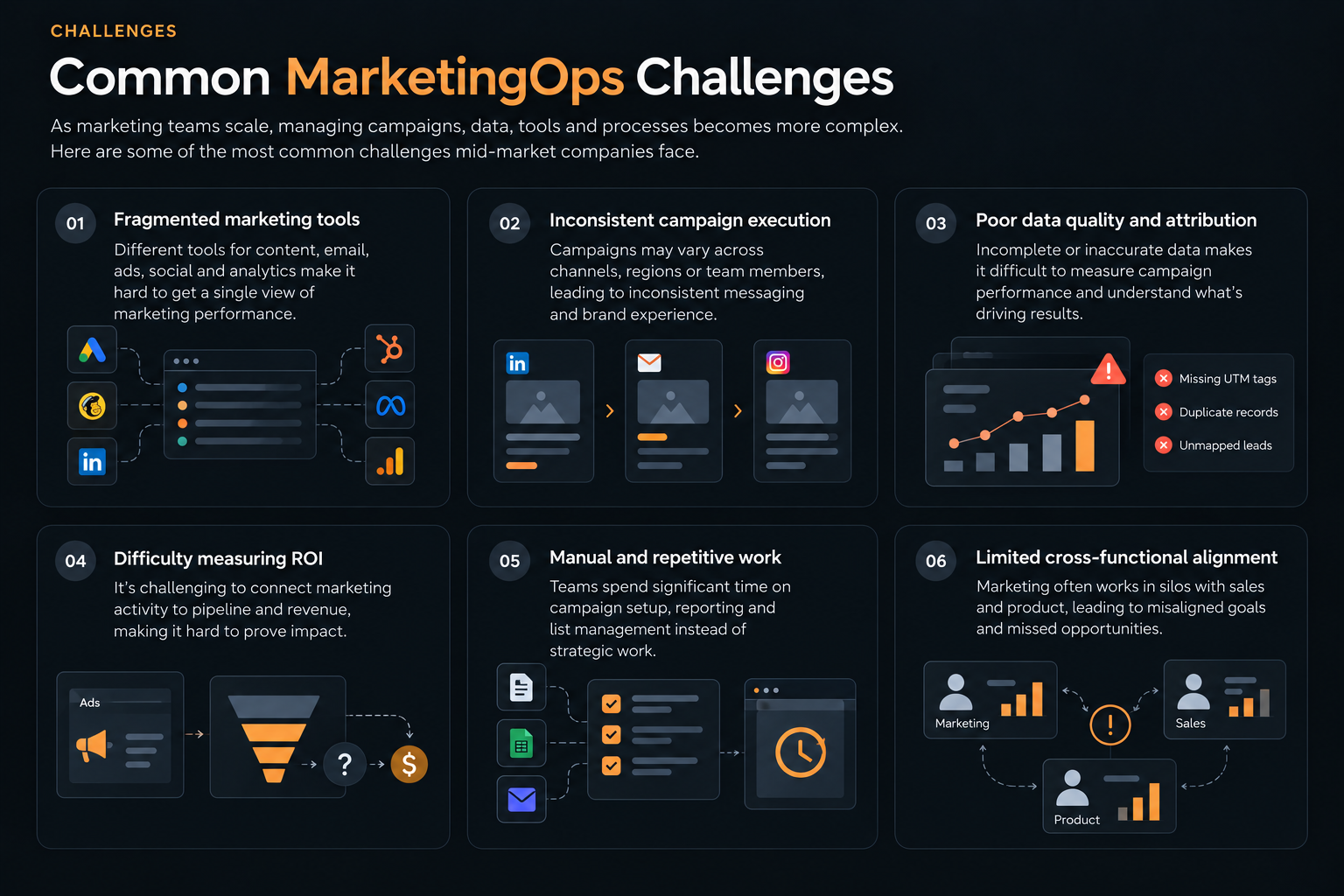
Common Marketing Ops Challenges
Fragmented marketing technology
Marketing teams often accumulate tools as new channels and needs emerge.
Without governance, the stack becomes difficult to manage.
Inconsistent marketing data
Different systems may use different definitions, fields, campaign names, or lifecycle stages.
Attribution complexity
Multiple campaigns and channels can influence the same customer journey.
Determining contribution therefore becomes difficult.
Manual reporting
Marketing teams can spend significant time collecting and combining information from different systems.
Weak sales handoffs
Leads may be generated successfully but not transferred to sales consistently.
Scaling complexity
Processes that worked with a small marketing team can become difficult when campaign volume and team size increase.
Marketing Ops Best Practices
Create a clear marketing data model.
Teams should agree on important fields, lifecycle stages, campaign definitions, and ownership.
Standardize campaign structures.
Consistent naming and tracking make reporting easier.
Define lead handoffs clearly.
Marketing and sales should agree on what happens when a lead reaches a particular stage.
Automate repetitive workflows.
Automation should reduce manual work without hiding important process logic.
Connect marketing and CRM systems.
Important campaign and customer information should not remain isolated.
Establish attribution rules.
Teams should agree on how marketing contribution will be measured.
Audit the marketing stack regularly.
Every tool should have a clear purpose and owner.
Marketing Ops Software: What to Look For
| Capability | Why it matters |
|---|---|
| Marketing automation | Runs repeatable campaigns and workflows |
| CRM | Connects marketing activity with customer and opportunity information |
| Analytics | Measures campaign and funnel performance |
| Advertising platforms | Manage paid acquisition activity |
| CMS | Supports website and content operations |
| Attribution | Helps understand campaign contribution |
| Data enrichment | Improves audience and account information |
| Workflow automation | Reduces repetitive operational work |
The objective is not to build the largest marketing technology stack.
It is to create a system in which marketing processes can be executed, measured, and improved consistently.
How AI Is Transforming Marketing Ops in 2026
AI is increasingly becoming useful for the repetitive and analytical parts of MarketingOps.
It can help summarize campaign performance, identify unusual changes, organize information, assist with lead enrichment, and reduce repetitive reporting work.
For example, instead of manually reviewing dozens of campaigns, a marketing team could use AI to identify campaigns whose performance has changed significantly and then examine those campaigns more closely.
AI can also help identify patterns across audiences, channels, and campaign activity.
But the output still needs context.
A drop in lead volume could be caused by campaign performance, budget changes, audience changes, tracking problems, website issues, or something happening elsewhere in the business.
AI can help narrow the investigation. It should not automatically turn a correlation into an explanation.
How Aitora Fits Into Marketing Ops
MarketingOps manages the systems and processes that make marketing work.
Aitora is focused on helping teams understand what is happening across those systems.
Imagine qualified leads decline for three consecutive weeks.
Marketing reporting can show the decline.
The next step is understanding what changed around it.
Were campaign volumes different? Did a particular audience change? Did sales activity change? Was there a change in the lead handoff process? Did another operational event occur around the same period?
Aitora is being built to connect these signals so teams can investigate the relationships around operational changes rather than manually pulling information from several systems.
MarketingOps continues to own the marketing operation.
Aitora provides another layer for understanding it.
Frequently Asked Questions
What is MarketingOps?
MarketingOps, or Marketing Operations, is the function responsible for the systems, processes, data, workflows, automation, and reporting that support marketing.
What does a MarketingOps Analyst or Manager do?
MarketingOps Analyst or Manager helps the marketing team operate efficiently by managing marketing systems, improving campaign processes, supporting automation and lead management, maintaining data and attribution, building reports, and identifying ways to improve marketing operations.
What is the difference between MarketingOps and RevOps?
MarketingOps focuses on marketing operations. RevOps is broader and coordinates operations across revenue-generating functions such as marketing, sales, and customer-facing teams.
What is the difference between MarketingOps and Marketing Intelligence?
MarketingOps helps marketing operate. Marketing intelligence focuses on understanding information about markets, audiences, campaigns, customers, and related signals.
Is MarketingOps part of RevOps?
It can be. In a RevOps organization, MarketingOps can operate as the specialized operational function supporting marketing.
When does a company need MarketingOps?
MarketingOps becomes increasingly useful when marketing has enough campaigns, channels, systems, data, and people that coordination can no longer be handled effectively through informal processes.
Want to see where your marketing workflow slows down? Get a free workflow diagnostic.