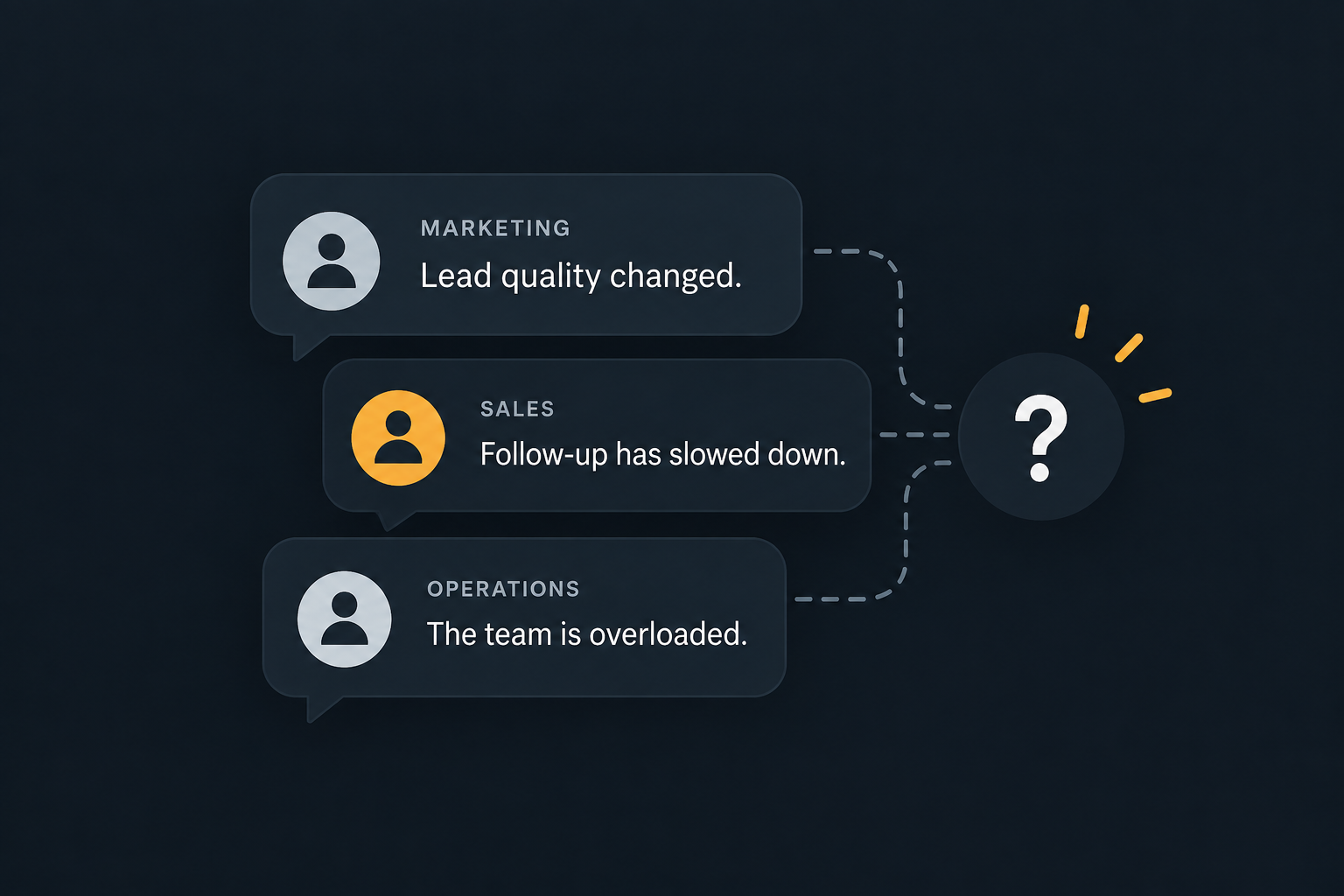
A campaign misses its number.
Marketing says lead quality changed.
Sales says follow up slowed down.
Operations says the team had too much on its plate.
Three explanations. No answer.
When the CEO asks "So what actually happened?" the room goes quiet. Someone opens a dashboard. Someone pulls up the CRM. Three days later, someone has a theory, built from old Slack messages and a spreadsheet nobody remembered existed.
That three day reconstruction isn't a one off. McKinsey studied it directly.
The $250 million is time, not bad judgment
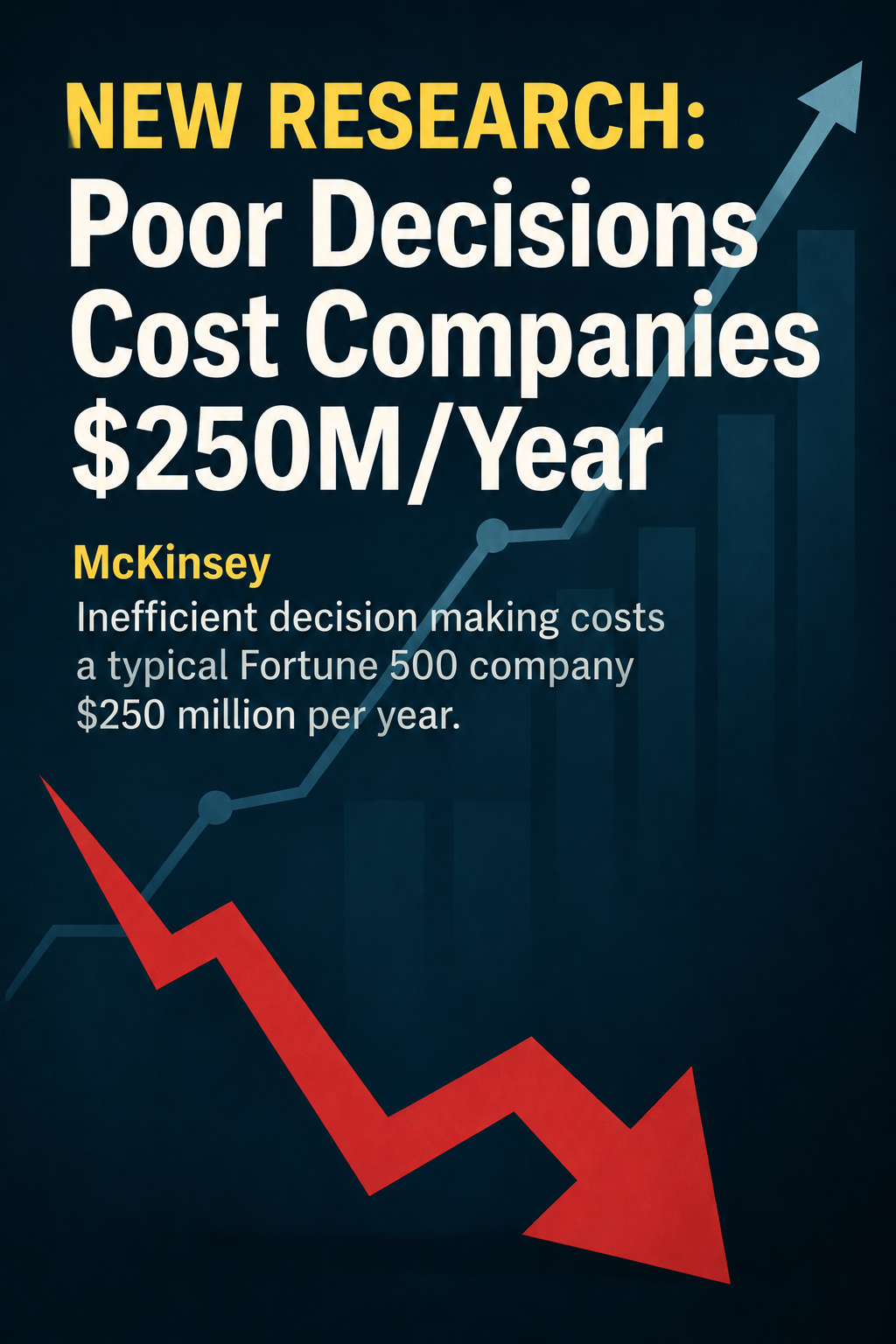
McKinsey surveyed more than 1,200 business leaders worldwide about how their companies make decisions. The result: poor decision making costs a typical Fortune 500 company roughly $250 million a year in wages.
That $250 million is a cost already buried in the P&L. But it's not a new expense the company chose to spend. It's the value of time the company is already paying managers for, going to reconstruction instead of decisions.
McKinsey measured that time directly: about 530,000 days of managers' time lost every year, at one typical Fortune 500 company. 61% of respondents said at least half that time is wasted. Only 37% said their decisions land both fast and good.
Here's the part that matters for a smaller company: that $250 million isn't leaders making worse calls than they used to. It's leaders spending most of their time figuring out what already happened, before they can decide what to do next. The judgment isn't the bottleneck. The reconstruction is.
And reconstruction is expensive precisely because the information that explains an outcome rarely lives in one place.
What that looks like in your pipeline
- Take a pricing change.
- It triggers more approvals.
- The approval queue backs up.
- Proposals go out later.
- Deals close later.
- Campaign timing stops matching sales capacity.
- Conversion drops and it shows up on the forecast weeks after the approval that actually caused it.
Pricing → approval → proposal → deal → conversion.
Your CRM has the deal stages. Your project tool has the approvals. A spreadsheet has the campaign dates. Each system is right about its own piece but none of them knows that the approval delay in one tool is about to become the conversion drop in another. Someone has to reconstruct that connection by hand, every time it happens. That reconstruction is exactly the time McKinsey is counting.
Adding a better dashboard doesn't close this gap. A dashboard summarizes one system well. It still can't trace a chain across three of them.
Signs it's already happening
- A forecast miss nobody can explain in the room only after someone spends days tracing it
- The same bottleneck returning every quarter under a different name
- Sales blaming lead quality, marketing blaming follow up speed, both partly right, neither seeing the full chain
- A single approver becoming a chokepoint across a dozen deals before anyone names the pattern
None of this means the data is wrong. It means the relationships between events live nowhere any one system can show you.
The gap isn't more data.
It is being able to trace what changed, what it affected, and where the effect eventually appeared.
That is the kind of organizational pattern Aitora is being built to trace.
Explore Aitora → aitora.io.